"How to pack a travel bag" sounds like a small question until you are kneeling at a security belt repacking in front of a queue. Good packing is a system, not a talent: the same order works for a trolley, a duffel and a backpack, and it is built around three judges — the scale (7 kg), the sizer (your dimensions) and the security officer (who wants your liquids and laptop out in seconds).
Layers, not piles: heavy at the base, flat in the middle, fast-access at the top.
The layer system
- Base layer — the heavy and hard: shoes (in shoe bags, soles outward), books, chargers' bricks. In a trolley this layer sits at the wheel end so the bag stands without tipping; in a backpack it sits against your back.
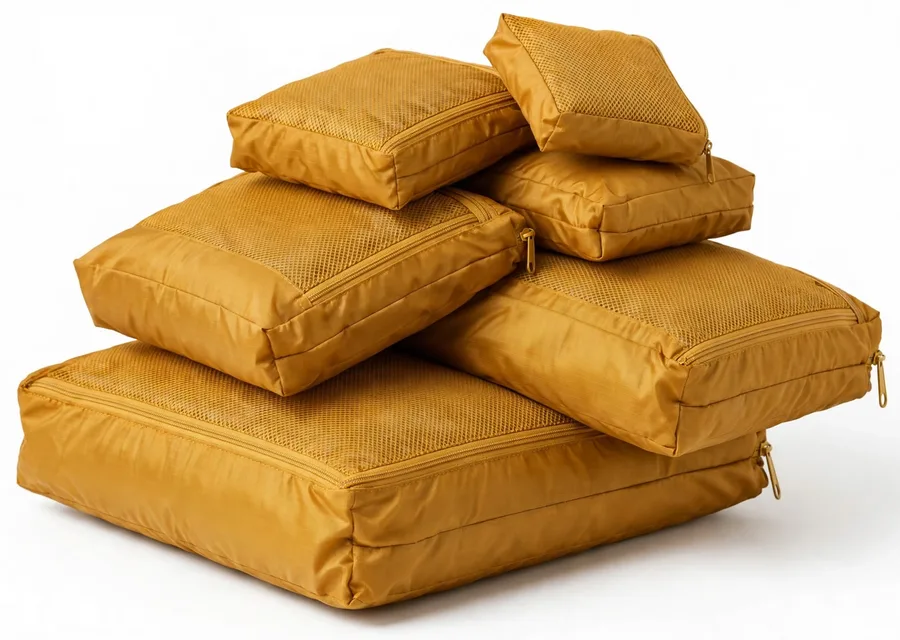
- Middle layer — clothes in cubes: roll soft clothes into packing cubes. Rolled clothes compress, do not crease as badly as folklore says, and leave no air pockets. Heavy fabrics (jeans, jackets) go lowest in this layer.
- Top layer — the security layer: your liquids pouch and toiletry organizer, laptop if it is not in its own compartment, and anything an officer might ask to see. Nothing in this layer should require digging.
- The grab layer — in the pocket or personal item: documents, medicines, power bank, one change of clothes, snacks. If the main bag is gate-checked, this layer is your trip insurance.
The 7 kg budget, spent wisely
Work backwards from the limit. On a 7 kg route with a 1 kg duffel you have 6 kg; with a 2.6 kg trolley you have 4.4 kg (the full maths is in the 7kg guide). Spend it in this order: wear the heaviest shoes and the jacket; pack clothes by days, not by "options" — three tops rotate with two bottoms; choose one colour family so everything matches everything; cut toiletries to travel sizes decanted into small bottles; and leave "just in case" items behind — Pakistan's cities have shops, and so does everywhere you are flying to. The failures of this discipline are catalogued, with love, in packing mistakes.
Cubes turn a soft bag into drawers: one for tops, one for bottoms, one for the small things.
Liquids, electronics and the non-negotiables
Liquids, gels and aerosols in hand carry are restricted to small containers, presented separately at security in most airports — keep them together in one pouch at the top of the bag. Power banks and spare batteries must be in the cabin and must never go in a checked bag; keep them in the grab layer. Medicines travel in original packaging where possible, with prescriptions for anything unusual. Documents, cash, jewellery and anything irreplaceable never go in a bag that might be gate-checked — that is what your personal item is for (see the handbag rule).
Bag-specific notes
Trolley: pack the wheel-end heavy; use the zip divider as the security layer. Duffel: cubes are structural — without them a duffel becomes a sack of regrets; shoe garage or end pocket for footwear. Backpack: heavy against the back panel, flat packing to protect the depth limit, straps tightened last (see backpack rules). In all three: leave 5% of the space empty. A bag packed to bursting is a bag that fails sizers, splits zips and cannot accept the one thing you buy at the destination.
The night-before checklist
- Weigh the packed bag; target at least 0.5 kg under your limit.
- Test the bag in an imaginary sizer: measure all three dimensions as packed.
- Liquids pouch and laptop reachable in under ten seconds.
- Documents, medicines, power bank in the personal item.
- One change of clothes accessible without full unpacking.
- Zips closed, straps tucked, nothing dangling outside.