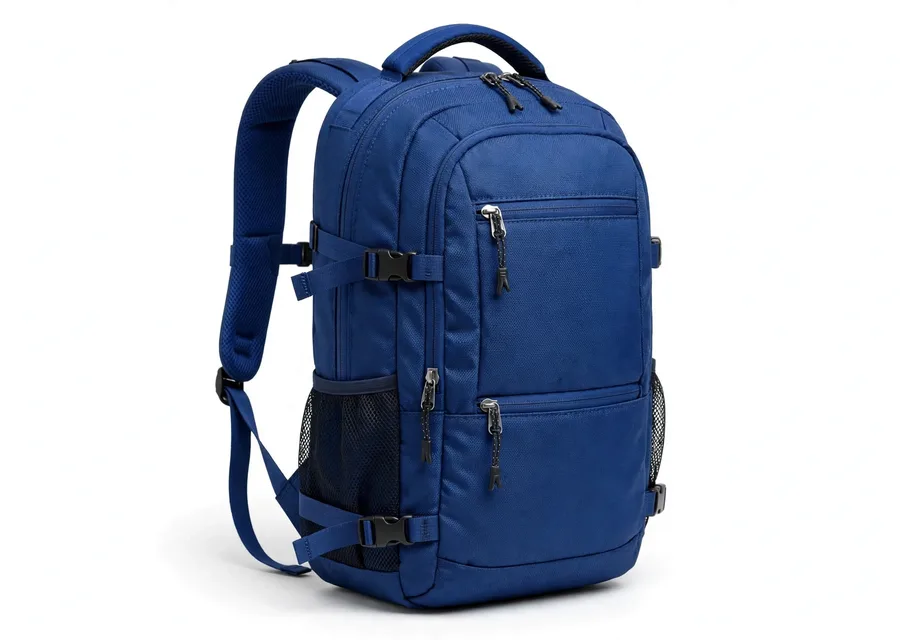
"Is backpack considered as hand carry" is one of the most-searched luggage questions from Pakistan, and it comes from a reasonable confusion: airlines publish suitcase-shaped dimensions, while a backpack is soft, round and changes shape with what is inside it. The rule itself is simple, and this page explains how it is applied in practice.
A backpack is judged exactly like a suitcase: three dimensions and one weight.
The rule: shape does not matter, measurements do
No major airline flying from Pakistan bans backpacks as a category. Your backpack must satisfy the same two tests as a trolley: its external dimensions must fit the airline's cabin limit — commonly around 55 x 40 x 20 cm, or a 45-inch total on SereneAir and AirSial — and its packed weight must be within the limit, usually 7 kg in economy. Pass both, and the backpack is your cabin bag. There is also a smaller role: a compact daypack that fits under the seat can serve as your personal item beside a main cabin bag, the pattern described in carrying two bags.
Why backpacks get rejected anyway
Three failure modes account for almost every rejected backpack. First, the stuffed-round problem: a 40-litre pack with a label size of 55 x 35 x 20 can bulge to 28 cm deep when packed hard, and depth is what sizers and locker doors punish. Second, dangling extras: sleeping mats, shoes tied to the outside and swinging straps make the measured object bigger than the bag. Third, hiking frames: packs with rigid external frames or heights above 55 cm were never cabin objects to begin with. All three are packing problems, not category problems — a travel backpack designed for cabins (the type compared in best hand carry bags) avoids them by shape.
Travel backpacks that open flat and hold a rectangular shape pass sizers that defeat round hiking packs.
How to pack a backpack so it stays cabin-sized
- Pack flat, not round: place the heaviest items against the back panel and keep the front face soft and compressible.
- Use packing cubes: cubes hold clothes in rectangular blocks that respect the depth limit — see the organizer set method in how to pack a hand carry bag.
- Nothing outside: shoes, bottles and mats go inside or stay home; external clutter is measured as part of the bag.
- Tame the straps: tighten compression straps, tuck hip-belt ends, and zip away shoulder straps if the pack allows — loose straps catch in lockers and read as extra bulk.
- Weigh it last: backpacks feel lighter than they are because the weight rides well. The scale, not your shoulders, is the judge.
Backpack sizes that work, by airline pattern
For the widely reported PIA limit (55 x 40 x 20 cm), any travel backpack up to about 40 litres with a rectangular shape passes when packed flat. For SereneAir and AirSial's 45-inch totals, add your three dimensions: a 52 x 34 x 20 cm pack totals about 42 inches and complies. For Qatar Airways' official 50 x 37 x 25 cm, height is the binding constraint — pick a pack no taller than 50 cm. Our shop's two backpacks were specced against exactly these numbers (a 35L cabin backpack at 52 x 34 x 20 cm and a 30L lightweight at 50 x 32 x 18 cm) if you want worked examples.